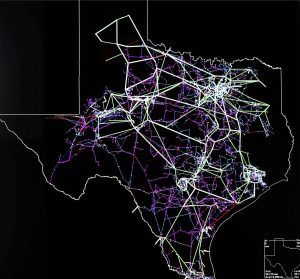
On October 24, 2025, ERCOT’s LLWG convened to address an agenda heavy with large load interconnection and behavior, and emerging stability risks in the grid. The meeting is of particular relevance given the surge in large load interconnection (data centers, AI-compute, industrial) connections and the evolving risk posture around bulk-system integration. Below is a brief overview of key takeaways of the LLWG meeting.
Large Load Interconnection & Interim VRT Assessment Process
The session began with an overview of ERCOT introducing the “Large Load Interconnection (LLI) process” and an interim voltage ride-through (VRT) assessment protocol. This is a critical development: as large loads proliferate, ERCOT has to ensure they do not present undue risk to system stability via ride-through shortfalls, fault-response issues or large abrupt power swings.
Key points:
- Developers and load owners must engage early with ERCOT and their Transmission Service Provider (TSP) to establish ride-through assumptions, fault clearing times, and interconnection modeling requirements.
- The interim VRT assessment process will likely require more detailed dynamic modeling of large loads (particularly those with fast, variable power demand) and coordination with protection and fault-ride-through requirements.
- ERCOT emphasized that large loads are no longer passive “load taps” but active grid participants whose behavior must be assessed in the same way as large generators.
For project developers and investors, this means that large‐load interconnection is gradually aligning more with generator interconnection rigor. At ZEG, we recommend a front-loaded modeling and commissioning strategy for large loads rather than treating them as afterthoughts.
Effectiveness of Transmission Upgrades in Terms of Loss of Load Reduction
ERCOT provided a status update on a study assessing how transmission upgrades mitigate load‐loss risk under contingencies for large electronic loads (LELs) in West Texas, Far West and Panhandle zones. Key findings included:
- The study region includes ~11.3 GW of the ~15.2 GW of LELs in the defined region.
- Contingency screening of ~370 buses at 345 kV level led to ~24 candidate buses and ~30 representative fault events wherein load loss exceeded 2,600 MW. Some events triggered loss up to ~6,452 MW.
- Different mitigation scenarios were tested: synchronous-condenser additions, large‐scale E-STATCOM deployment, and adjustments in load trip delay. Results indicated that simply “adding more transmission upgrades” (e.g., more E-STATCOMs) did not always significantly reduce load loss risk. On many cases, improving ride-through capability of the load itself was more effective.
- The study concluded that as more large loads connect, risk and magnitude of potential load-loss grow, and addressing load ride-through behavior may be more effective than only transmission reinforcement.
Implication: For large load developers and asset owners, transmission system upgrades are necessary but not sufficient; the internal ride-through, fault-response, and dynamic behavior of the load need to be part of the risk mitigation strategy. ZEG advises incorporating not only the load side but also grid‐interface behavior into project planning.
Investigation into Vulnerability of Synchronous Machines to Large Load Sub-Synchronous Active Power Variation
In an ERCOT presentation with support from Electranix, the focus shifted to how large loads — particularly those with rapid active power variation (such as AI data centers) — may induce torsional stress or instability in synchronous machines connected to the grid. Highlights:
- Identified that AI training loads, which often ramp or cycle power rapidly, can create active‐power variations that lead to significant torque oscillations on synchronous generator shafts (in simulation up to >100% torque in certain conditions) when the load is in close electrical proximity to the machine.
- Key risk factors: high ramp rates, co‐location of large load and generation, low impedance connection, torsional natural frequencies of machines (~10-15 Hz) coupling with oscillatory load demand.
- Recommendations: generator owners should monitor for potential resonance, large loads should consider smoothing or energy‐buffering solutions, and system planners should refine criteria for acceptable dynamic behavior of loads.
- ERCOT expects to publish the final report in Q1 2026 and has invited stakeholder feedback on mitigation criteria.
This topic is quite forward-looking but increasingly relevant: as multi-gigawatt large loads join the grid, even subtle dynamic behaviors can have non-trivial system impacts. We recommend large‐load developers treat dynamic load behavior (not just steady-state demand) as a grid-integration risk item.
Other Agenda Items & Forward Next Steps
Additional agenda items included the 2026 Large Load RFI, a discussion of single‐source data for large-load metrics, recent large‐load events and load cluster study concepts along with an AI-data-center integration/mitigation topic and EPC Power’s grid‐forming BESS for AI loads.
From a take-away standpoint, large-load stakeholders should:
- Review their interconnection study documentation, especially ride-through/VRT assumptions, fault clearing time, and dynamic model fidelity.
- Conduct internal gap assessments on dynamic load behavior: ramp-rates, power cycles, proximity to synchronous machines, energy-buffer design.
- Engage early with ERCOT, TSPs and equipment vendors about modelling expectations, telemetry/data requirements, and large‐load dynamic behaviour validation.
- Plan for the possibility of higher scrutiny and requirement growth in 2026-27 for large loads, especially those of AI/data-centre scale.
We specialize in helping both developers and asset owners of large loads (including data center, industrial, hydrogen and AI-compute) navigate the evolving grid interaction, interconnection and reliability landscape. If you’re planning a large load interconnection to ERCOT, need to validate your dynamic load behavior, assess ride-through risks or align your project with ERCOT’s LLWG expectations — let’s talk. Request a demo or contact our team to schedule a review of your large-load grid readiness.
For more on ERCOT, Large load interconnection, stability risks, and data centers, view Meeting Materials here.