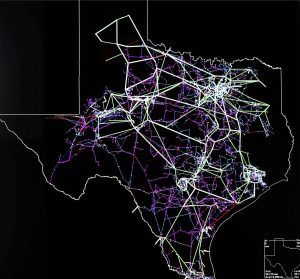
ERCOT’s Large Load Working Group (LLWG) met on September 19, 2025 to address reliability challenges driven by rapid large electronic load (LEL) growth across Texas. Topics included the effectiveness of transmission upgrades, proposed voltage ride-through (VRT) standards, frequency-limit analysis, Far West Texas Interconnection Reliability Operating Limit (IROL) concerns, Controllable Load Resource (CLR) planning ahead of NPRR1188, and concepts for load cluster studies. Below is a summary of key items discussed.
Key Discussion Items from ERCOT LLWG
1. Transmission Upgrades vs. Load-Loss Reduction
ERCOT presented a planning study examining how major 345-kV and 765-kV upgrades could reduce involuntary load loss in West, Far West, and Panhandle regions. Using a 2030/2031 study case with ~15.2 GW of modeled LELs, engineers screened three-phase contingencies and identified a 2,600 MW load-loss threshold—the critical point for triggering significant frequency excursions. Next steps include evaluating synchronous condensers and E-STATCOMs, with findings expected in Q4 2025.
2. Voltage Ride-Through (VRT) Requirements
ERCOT shared the latest status on proposed VRT criteria for LELs, including candidate ride-through curves. Stakeholders were reminded to submit equipment capability data to inform final rulemaking.
3. Large Load Model Survey
ERCOT updated the group on its ongoing survey to capture real-world LEL model and ride-through settings, ensuring planning models reflect actual equipment behavior.
4. Frequency-Limit Study
A related frequency analysis confirmed that losses exceeding 2,600 MW could push ERCOT system frequency above 60.4 Hz, underscoring the urgency of transmission reinforcements and ride-through compliance.
5. Far West Texas IROL
ERCOT reported on emerging IROL concerns in Far West Texas, highlighting the need for additional dynamic line ratings and potential 765-kV reinforcements to maintain stability amid surging load growth.
6. Controllable Load Resources & NPRR1188
ERCOT reviewed planning implications for CLR interconnections under NPRR1188, focusing on commissioning plan documentation, Manual System Adjustments, and new study requirements for large controllable loads.
7. Load Cluster Study Concepts
ERCOT introduced a framework for cluster studies to evaluate the combined impact of geographically concentrated LELs, aiming to streamline planning and identify shared infrastructure needs.
Developer Implications
- Site Selection: Locate near planned 345/765-kV reinforcements to reduce risk of involuntary trips.
- Equipment Design: Ensure facility protection schemes meet ERCOT’s developing VRT criteria.
- Frequency Risk: Incorporate the 2,600 MW threshold in reliability and commissioning analyses.
- CLR Strategy: Prepare early for NPRR1188 requirements to avoid energization delays.
Large-load developers—from hyperscale data centers to advanced manufacturing facilities—face unprecedented ERCOT planning complexity. We combine proprietary siting software and deep engineering expertise to model VRT sensitivities, frequency-loss thresholds, and IROL constraints. Contact ZEG today to de-risk your Texas interconnection strategy and move from prospect to energized site with confidence.
View Meeting Materials Here.