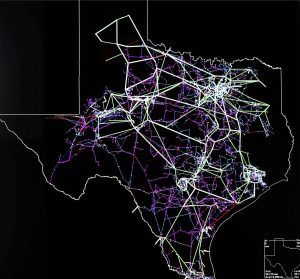
At the July meeting of ERCOT’s Technical Advisory Committee (TAC), discussions centered around improving the model-building process through better integration of GIS data and clearer communication between ERCOT and stakeholders. The meeting also addressed enhancements in extraordinary dispatch modeling, stakeholder data submissions, and the evolving role of the SSWG in planning activities.
Enhancing the Modeling Sequence with GIS as the Source of Truth
ERCOT described recent updates to its modeling process, noting that the current approach now begins by removing all of SSWG’s extraordinary dispatch units. These units are then selectively reintroduced based on the most recent information in ERCOT’s Geographic Information System (GIS). This workflow improves consistency and ensures that only validated and current project data is used in scenario planning.
The GIS is now considered the authoritative source for model inclusion, replacing earlier workflows that relied more heavily on stakeholder-provided inputs. By using GIS data as the baseline, ERCOT aims to reduce redundancy and avoid conflicts between different planning groups’ models.
Clarifying Stakeholder Roles in Data Submission
Stakeholders raised questions about when and how they should engage with ERCOT to adjust or clarify project information—especially in cases where discrepancies arise between what appears in the GIS and what is listed in the SSWG model. ERCOT explained that if stakeholders notice projects in the GIS that are not yet reflected in the Current Day Reliability (CDR) model, they should submit a model update request and notify ERCOT Planning directly.
It was emphasized that even if a project is visible in the GIS, it does not automatically trigger its inclusion in planning models unless specific conditions are met. This underscores the importance of proactive communication and formal documentation when proposing changes to model inputs.
Improved Modeling of GINRs
The meeting also included updates on the handling of Generation Interconnection and Notification Requests (GINRs). ERCOT clarified that not all GINRs visible in the GIS are automatically modeled. Instead, internal processes identify and flag GINRs for inclusion based on criteria such as project maturity, geographic placement, and interconnection stage.
Stakeholders were reminded that visibility of a project in the GIS does not equate to inclusion in planning assumptions. Formal review and coordination remain critical steps before projects can be added to models used for transmission planning and reliability studies.
Aligning the GIS and SSWG Modeling Workflows
There was significant interest in how the GIS and SSWG models interact, and how inconsistencies between them are resolved. ERCOT acknowledged that alignment is still a work in progress but improving with each update. Stakeholders requested a clearer, visual explanation of how GIS data flows through ERCOT’s planning processes and into the CDR and other key planning models.
ERCOT committed to preparing a step-by-step walkthrough for a future TAC meeting to clarify how the modeling sequence unfolds and to specify the points at which stakeholders should engage.
Key Takeaways
The July TAC meeting reinforced ERCOT’s focus on refining the modeling process through improved data governance and clearer communication pathways. GIS has become the central system for tracking project development, with a defined process for updating model inputs and resolving conflicts across working groups. While there are still areas for improvement—particularly in how GIS, SSWG, and CDR data align—ERCOT’s commitment to increased transparency and coordination was evident throughout the discussion.
Stakeholders can expect follow-up materials from ERCOT detailing the modeling workflow and can continue to submit model update requests and project clarifications through formal channels as the system evolves.
Stay Ahead of the Curve
Zero Emission Grid actively tracks and interprets ERCOT stakeholder activity so you don’t have to. Whether you’re navigating POI requirements or planning your next interconnection, our team is ready to support your path to development.
Contact ZEG today to accelerate your path to a resilient, decarbonized power grid.
View Meeting Materials here.