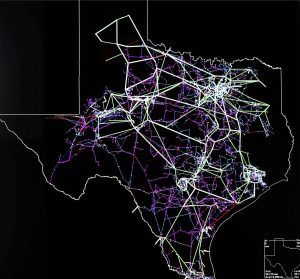
Advancing LELs into ERCOT
In July 2025, ERCOT hosted its large load working group meeting to address the evolving challenges of integrating Large Electronic Loads (LELs) into the Texas power grid. With rapid growth in data centers, crypto mining, and advanced industrial facilities, ERCOT is focused on developing both interim and long-term voltage ride-through standards to ensure system reliability. This comprehensive session covered operational approaches in the absence of a formal standard, the collaborative roles of Transmission Service Providers (TSPs) and market participants, cost allocation issues, and emerging technology considerations. Stakeholders engaged in in-depth discussions aimed at balancing immediate grid stability needs with future regulatory frameworks to support sustainable, reliable grid growth.
Interim Load Ride-Through Assessment: A System Reliability Lens
With no formally adopted ride-through standard currently in place, ERCOT is relying on system operations-based analysis to evaluate how new LELs affect voltage stability. ERCOT emphasized that during fault simulations, if a load trips offline—even if it meets ERCOT’s proposed ride-through curves—it may still be subject to curtailment if its disconnection leads to a System Operating Limit (SOL) violation.
ERCOT clarified that this approach does not imply new curtailment criteria but reinforces the importance of grid stability under current operating conditions. Any load that triggers an SOL exceedance during contingency scenarios will face constraints, regardless of technical compliance with a not-yet-finalized standard.
Long-Term Vision: Aligning Large Load Requirements with ERCOT’s Operational Philosophy
ERCOT articulated a long-term vision that mirrors its generator requirements: just as generators must meet a minimum 0.95 power factor for reactive support, loads will eventually be required to meet a minimum ride-through capability. The future state anticipates that all LELs (e.g., data centers, crypto facilities, high-VFD industrial sites) will adhere to a codified standard (likely via NOGRR). ERCOT and stakeholders agreed this must be done in tandem with an expanded understanding of grid-side support needs.
A key concern raised was how and when a load would transition from being considered “non-compliant” to compliant. ERCOT clarified that until a formal standard is adopted, load interconnection decisions will continue to be evaluated on a case-by-case basis through ongoing operational studies.
Transmission Solutions & TSP Roles: Bridging the Reliability Gap
Multiple stakeholders expressed frustration that system-level solutions (e.g., STATCOMs, synchronous condensers, grid-side batteries) were not being adequately considered or funded. ERCOT confirmed that PGRR122 was specifically intended to develop planning criteria for transmission-side support but has stalled due to a lack of consensus on how much support is “enough.” ERCOT is currently analyzing the cost-effectiveness and impact of grid-side investments in key areas like the Panhandle and West Texas. The goal is to determine where additional reactive support or ride-through investments bring diminishing returns—and how much cost can justifiably be socialized.
TSPs noted that without clear direction or guaranteed cost recovery, projects that might solve regional stability concerns remain unjustified under current planning protocols.
Cost Allocation: Who Pays for Grid Stability?
The conversation shifted to cost allocation concerns. Stakeholders questioned why new LELs must shoulder ride-through or curtailment burdens when legacy large industrial users (e.g., steel mills) have operated without such scrutiny or costs. ERCOT acknowledged the imbalance and confirmed that any future NOGRR-based requirements would be forward-looking and not retroactively applied to existing loads.
There was consensus that ERCOT and the PUC should revisit broader market reforms, including how frequency response, voltage control, and other reliability services are funded—particularly as load shapes become more complex and fast-acting.
Technology Coordination: Beyond UPS and Ride-Through Curves
Several stakeholders cautioned against relying too heavily on on-site UPS systems as the primary ride-through solution. They called for a more holistic evaluation of load-side and grid-side responses during low voltage, high frequency, and oscillatory events.
Suggestions included deeper exploration of:
- Inverter-based resource behaviors
- Grid-forming battery systems
- Reactive compensation from TSPs
- Enhanced load modeling for VFD-heavy facilities (like hydrogen and crypto)
- ERCOT agreed that future workshops will expand beyond UPS behavior to include broader technological coordination.
- ERCOT also acknowledged current modeling gaps in how emerging technologies impact system dynamics.
Ride-Through Survey & RFI Process: Balancing Urgency with Data Quality
Ride-Through Survey & RFI Process: Balancing Urgency with Data Quality
ERCOT noted that its current Request for Information (RFI) process is a critical input to its studies. Some stakeholders raised concerns that commercial constraints, confidentiality, and limited engineering bandwidth make the timeline challenging.
ERCOT confirmed that it would proceed with the data available by August, and make conservative assumptions where data is missing. Loads that fail to provide detailed ride-through profiles may be modeled less favorably, potentially impacting their ability to connect or avoid curtailment. Stakeholders were encouraged to prioritize the most relevant data for submission and to consider submitting only key parameters if full engineering studies are not yet available.
The Future for LELs
- ERCOT will continue interim evaluations of ride-through using real-world fault scenarios to assess SOL impacts.
- A formal standard for LEL ride-through will be developed, likely via a Nodal Operating Guide Revision Request (NOGRR).
- ERCOT is actively studying transmission-side support options, particularly in the Panhandle and West Texas.
- Further stakeholder workshops will explore coordinated solutions beyond UPS—including TSP investments, grid-forming batteries, and advanced control strategies.
- ERCOT will publish study results based on submitted ride-through data later in the year.
This session underscored ERCOT’s balancing act between immediate reliability needs and the evolution toward a formal, enforceable ride-through standard. Stakeholders reiterated the importance of transparency, shared responsibility, and planning certainty in ensuring grid stability as LEL growth accelerates.
Optimizing Large Load Integration in ERCOT: Expert Solutions from Zero Emission Grid
Navigating ERCOT’s evolving Large Electronic Load requirements and ride-through standards is complex—but you don’t have to do it alone. At ZEG, our deep expertise in ERCOT market rules, grid reliability standards, and transmission planning empowers your project to move forward smoothly and confidently. Whether you’re a data center, crypto facility, or industrial operator, we deliver customized solutions to optimize interconnection, minimize curtailments, and ensure compliance with emerging ride-through standards. Partner with ZEG today to turn ERCOT challenges into competitive advantages and future-proof your large load operations.
View Meeting Materials here.