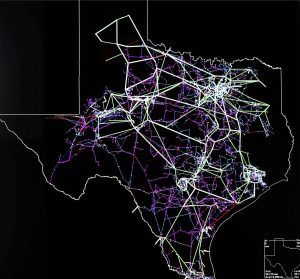
As Texas continues to navigate a rapidly evolving energy landscape, the 2025 ERCOT Innovation Summit, held Tuesday, May 6, served as a high-impact forum for energy professionals, researchers, and system operators to collectively assess the state of grid modernization—and map out the road ahead.
Reimagining Grid Transformation
Prashant Kansal, ERCOT’s Director of Grid Transformation, opened with a vision grounded in dual priorities: stabilize today’s reliability risks while accelerating long-term R&D for grid architecture evolution.
The panel outlined active pilots and near-term solutions, including AI-enhanced system forecasting, integration of distributed energy resources (DERs) at scale, and deployment of grid-forming inverters to support frequency and voltage stability. They also emphasized the need to modernize transmission planning to reflect non-linear, location-specific growth—especially as new loads emerge in places with limited grid headroom.
Kansal underscored ERCOT’s expanded partnerships with external research groups, creating pathways to test ideas quickly without compromising grid integrity. Several speakers also acknowledged how pending legislation, including Senate Bill 715 and House Bill 3356, could shift the ground rules for renewable and DER integration—especially around backup power requirements and performance standards.
Data Centers: Bridging Urgent Load with Long-Term Grid Strategy
Texas is rapidly becoming the data center capital of the U.S.—and that growth is stressing the limits of existing infrastructure. In a session led by Bill Blevins, Director of Grid Coordination at ERCOT, panelists explored how hyperscale operators are siting facilities in regions where grid capacity is already tight, creating localized bottlenecks.
The discussion covered adaptive strategies, such as colocated generation, flexible transmission agreements, and load optimization through software-driven scheduling. ERCOT is also expanding grid visibility tools and interconnection protocols to improve situational awareness as these campuses come online at breakneck speed.
A notable policy touchpoint was Senate Bill 6, which would increase load forecasting obligations for large energy users—signaling a push toward greater planning accountability across industrial sectors.
The New Face of Demand Response
Demand response is no longer just emergency curtailment—it’s a strategic tool for real-time grid flexibility. Gordon Drake, Director of Market Design and Analysis, led a forward-looking discussion on the role of behind-the-meter assets, price-responsive loads, and orchestration platforms in shaping the next generation of grid services.
Panelists addressed persistent regulatory barriers, particularly for smaller or aggregated resources, and emphasized the need for new frameworks around data sharing, device interoperability, and compensation models that reflect the real-time value of load flexibility. As storage and CHP systems become more dynamic participants, a more inclusive market design is essential.
Planning in a World of Uncertainty
As climate volatility increases and load profiles shift, deterministic planning methods are proving inadequate. In a session moderated by Pete Warnken, Director of Resource Adequacy, ERCOT showcased its transition to probabilistic risk modeling—a toolset that explores thousands of future-state scenarios to identify rare but consequential risks.
This method enables more informed investment signals, operational guidance, and resource adequacy evaluations. The goal, Warnken emphasized, is to integrate probabilistic analysis as a living input into decision-making, rather than as a retrospective assessment.
ISO Collaboration in a Fragmented Grid
ERCOT’s Nitika Mago, Senior Manager of Balancing Operations and Planning, hosted a panel on multi-ISO collaboration. Representatives from CAISO, PJM, MISO, and NYISO shared how their organizations are coordinating innovation despite varying market structures and regulatory environments.
Topics ranged from virtual power plant integration and enhanced contingency forecasting to workforce development, where cybersecurity, data analytics, and systems engineering are becoming baseline skills. All agreed that peer coordination across ISOs is not just helpful—it’s necessary to scale the technologies and operating models that the energy transition demands.
The Summit’s Core Message: Innovation Requires Collaboration
From every corner of the grid—technology, operations, planning, markets—a recurring theme emerged: no organization can solve this transformation alone. ERCOT and its partners are building trust-based frameworks for experimentation and progress. And while technology enables change, it’s shared vision and strategic alignment that make it scalable.
At ZEG, we support the developers, operators, and market participants who are actively shaping this transformation. Whether you’re preparing a DEFR study, evaluating interconnection risks, or tracking the policy impacts of new legislation, we bring technical depth and grid strategy expertise to your most complex challenges.
Let’s build the grid we need—together.
Contact us to get started.