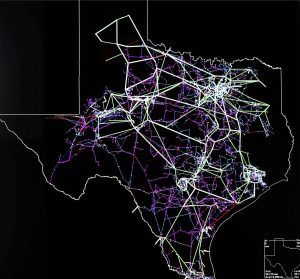
The ERCOT LLWG agenda covered updates from NERC on regulatory actions, ERCOT’s large load interconnection queue and Batch Zero progress, and detailed discussions on power variation limits, frequency limits, and dynamic modeling – PGRR144. The session also included industry presentations showcasing technologies aimed at improving voltage ride-through, ramp-rate control, and overall grid compatibility of large loads.
(1.) NERC Update – Large Load Integration
NERC is formally expanding oversight to large loads, especially data centers and crypto facilities. NERC has proposed new registry criteria introducing a Computational Load Entity (CLE) for large loads.
New category: Computational Load Entity (CLE)
Applies if:
- ≥20 MW aggregate load
- Connected at a single POI to the BPS ≥60 kV
- ≥1 MW computational load
New Reliability Standard (Project 2026-02) to create specific reliability requirements for computational load entities.
Focus areas: Modeling requirements, Operational coordination and Protection/control systems. Increased regulatory oversight is expected, including use of Level 3 Essential Actions alerts for computational loads to address emerging reliability risks.
2. Batch Zero Study Update
- ERCOT provided the Batch Study update with PGRR145 aligned to recent PUCT guidance, including changes toward maturity-based eligibility, simplified frameworks, and improved allocation logic.
- Stakeholder concerns raised:
- Issues with power supply contract timing (dependency between baseload status and tenant commitments)
- Lack of clarity on financial security requirements (refundability, implementation, consistency)
- Concerns on project inclusion scope (RPG) and need for broader eligibility
Key Elements
(A.) Year 6 Allocation Problem
- Challenge: balancing customer certainty vs transmission feasibility
- Three approaches discussed:
- Full upfront allocation → unrealistic transmission timelines
- Rollover → uncertainty for developers
- Proposed: “Bookend approach”
- Study key years (2, 4, 6)
- Provide full trajectory while reducing study complexity
- Enables a 6-year actionable plan
- Stakeholder concern:
- For years not explicitly studied, load allocation may remain unchanged, reducing clarity and flexibility
- ERCOT refinement (Option 3B):
- Extend batch study timeline by ~2–3 months
- Enable allocation for intermediate (non-studied) years
(B.) Provisional Controllable Load Resource (PCLR)
- Hybrid concept:
- Part firm load (LPC)
- Part dispatchable (flexible load)
- Key features:
- Flexible portion dispatchable via SCED
- Dynamic bid capping to manage transmission constraints
- Cannot provide ancillary services
- Must follow real-time dispatch signals
(C.) BYOG (Bring Your Own Generation)
- Framework broadly well received
- Open questions remain on:
- Eligibility criteria
- Interaction with existing constructs (PUN/SLF, etc.)
- Study requirements and implementation details
(3.) LEL Frequency Limit & LCL Power Variation Update
- ERCOT presented updates on LEL frequency stability limits, focusing on system response to large load loss events
- Updated studies confirm a ~3,200 MW load loss limit to maintain frequency below ~60.4 Hz.
- Analysis of Fast Frequency Response (FFR) shows that additional FFR can improve the load loss limit (approximately 1:1 MW benefit)
- In parallel, ERCOT discussed Large Computational Load (LCL) power variation limits to address reliability risks.
- Proposed limit: 10 MW variation within any 5-second window to mitigate oscillations and synchronous generator impacts
- These variations can introduce sub-synchronous interactions and mechanical stress on nearby generators
- Key clarification:
- ERCOT confirmed that the 10 MW / 5-second limit will apply to existing loads as well, not just new interconnections.
(4.) PGRR144 – Dynamic Modeling Requirements for Large Loads
- ERCOT presented updates to PGRR144, focusing on enhanced dynamic model submission, validation, and review requirements for Large Loads (especially LELs)
- Stakeholder concerns:
- Voltage Ride-Through (VRT) testing requirement could be interpreted as a mandatory performance obligation, especially for non-LELs
- Existing operational loads may be forced to re-enter the interconnection (LLIS) process for any modification, potentially impacting ongoing operations
- ERCOT response / clarification:
- VRT testing is intended only to validate dynamic model performance under disturbance conditions, not to impose new compliance requirements on non-LELs.
- Review of modifications applies only when changes materially impact dynamic behavior, particularly ride-through capability, and does not restrict current operations.
- Technical outcome:
- Reinforces the need for accurate, disturbance-validated dynamic models
- Ensures system studies capture realistic load behavior during faults and transient events
(5.) Large Load Interconnection Status
- ~9 GW approved to energize, but ERCOT has observed a non-simultaneous monthly peak consumption of ~4 GW and ~3.7 GW simultaneous peak in March 2026 indicating diversity in usage patterns.
- Queue includes many projects with low maturity (e.g., “no studies submitted”), highlighting speculative pipeline challenges.
(6.) Industry Solutions for Grid-Friendly Large Loads
Industry presentations (EdgeTune Power, DIMAAG, ON.energy) focused on addressing grid stability challenges from AI/data center loads, including rapid load variations and oscillatory behavior.
(A.) Common Problems Identified:
- AI/data centers introduce:
- Rapid load swings
- High-frequency oscillations
- Low tolerance for interruptions
- Voltage ride-through challenges
(B.) Solutions
DIMAAG
- 800 V DC architecture
- Benefits:
- Reduced AC-side fluctuations
- Built-in load smoothing
- Improved LVRT capability
ON.energy
- AI UPS (battery + inverter-based system)
- Key concept:
- Entire facility behaves like a controllable BESS
- Decouples load from grid disturbances
- Enables:
- Peak shaving
- Zero-interruption operation
- Ramp control
EdgeTune Power
- Energy Storage (Parallel and IN-line UPS)
- Importance of:
- Controller delays (ms-scale impacts stability)
- Real-time testing (HIL, digital twins)
Conclusion
Overall, the meeting highlighted ERCOT’s progress in developing a structured and reliability-focused framework for large load integration. Key initiatives such as Batch Zero aim to improve planning certainty and align load growth with transmission readiness, while PGRR144 strengthens dynamic modeling and validation requirements to ensure accurate system representation of large loads. In parallel, discussions on LCL power variation limits (10 MW / 5 sec) and LEL frequency stability limits (~3,200 MW) reflect increasing focus on operational reliability and system stability impacts.
Contact ZEG to evaluate how ERCOT’s evolving large load requirements, modeling standards, and interconnection frameworks impact your project strategy and grid integration approach.
More from ERCOT this month:
ERCOT Large Load QSA Explained (2026): Requirements and Timeline
ERCOT Batch Study Process for Large Load Interconnections Workshop #7 –Summary
ERCOT Generator QSA Requirements (2026): Modeling, Timeline & Approval Process