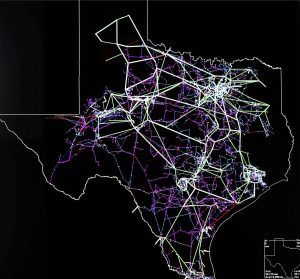
Summary of ERCOT Large Load Working Group held February 19, 2026, covering Batch Study Enablement, and Advanced Planning Tools
ERCOT LLWG Overview
ERCOT LLWG convened to continue detailed technical and procedural discussions around large electronic load (LEL) integration, with a particular focus on batch study scalability, transmission planning assumptions, and tooling capable of accelerating planning-grade analysis. The meeting featured an extended technical demonstration and stakeholder Q&A centered on how advanced study tools could support ERCOT’s evolving large-load interconnection framework.
The session attracted participation from transmission service providers, developers (including data center and storage developers), consultants, and ERCOT staff, reflecting growing urgency around managing multi-GW large-load queues under tight reliability and administrative constraints. Below is a comprehensive summary of key takeaways from the ERCOT LLWG Feb. 19 meeting.
Study Framework Demonstrated
The technical discussion centered on a planning-grade demonstration using ERCOT’s 2031 Summer Peak RTP base case, which includes approximately 162 GW of system load. For illustrative purposes:
- An incremental 5 GW large load was added at a West Texas substation.
- Load was offset elsewhere in the system to preserve overall load balance, emphasizing that this step was model preparation, not a mitigation strategy.
- ERCOT staff and presenters clarified that generation re-dispatch, load flexibility, and storage response can all be configured as study options depending on the rules applied.
The study evaluated P1–P7 contingencies, including N-1-1 events, using a contingency set on the order of ~16,000 cases, with intelligent pre-screening to focus on contingencies most relevant to the added load while still ensuring no critical violations were missed.
Key Technical Capabilities Discussed
Across the Q&A, several capabilities drew sustained attention:
- Mitigation breadth: Beyond traditional new-build transmission, the tool demonstrated the ability to explore reconductoring, generation re-dispatch, load flexibility, and behind-the-meter generation or storage as potential mitigation paths.
- Contingency handling: The software differentiates between numerical non-convergence and true stability issues, applying automated techniques to improve convergence where possible.
- TPL awareness: Stakeholders confirmed that mitigation logic respects TPL contingency categories, enabling re-dispatch or flexibility only where allowed.
- Multi-case optimization: While the demo focused on a single summer-peak case, ERCOT and stakeholders emphasized the need to optimize solutions across multiple operating conditions (e.g., off-peak, no-solar, high renewable output) before applying results in a batch process.
- Configurability: ERCOT underscored that generation assumptions, load ramp behavior, no-go transmission corridors, and right-of-way constraints must remain configurable to reflect real-world constraints and TSP input.
Administrative and Process Takeaways
As the meeting progressed, discussion shifted from pure technical feasibility to process risk:
- ERCOT staff emphasized that large-load integration is no longer a purely technical problem; the dominant challenge is administrative coordination across ERCOT, TSPs, and developers.
- A recurring theme was the need for pilot or “pre-match” trial studies before formal batch implementation, allowing ERCOT to stress-test assumptions, timelines, and workflows without binding outcomes.
- Stakeholders highlighted the importance of transparency—both in model inputs and in how sensitivities are handled within batch studies.
- ERCOT reiterated that while results from pilots may inform future processes, formal batch outcomes remain governed by approved protocols.
In the final portion of the meeting, ERCOT reinforced that internal pilots are already underway, with further discussion expected in upcoming workshops to align batch study design, RPG integration, and stakeholder expectations.
What This Means for Large-Load Developers
The discussion reinforced several practical realities for large-load projects in ERCOT:
- Early planning-grade analysis is becoming essential to avoid late-stage cost or schedule surprises.
- Transmission solutions will increasingly be evaluated alongside flexibility and operational commitments, not just steel-in-the-ground upgrades.
- Developers should expect iterative study cycles as batch processes mature, especially where partial participation, load resizing, or flexibility options are considered.
Large-load Interconnection in ERCOT
Large-load interconnection in ERCOT is moving fast, and the rules, assumptions, and study expectations are still evolving. ZEG helps developers, data center operators, and infrastructure investors navigate this uncertainty by providing early-stage screening, planning-grade studies, and independent technical insight aligned with ERCOT’s latest frameworks.
If you’re evaluating large-load siting, batch study exposure, or transmission risk in ERCOT, let us can help you get clarity early, before decisions become expensive. Contact us to discuss your project
For more on ERCOT Large-Loads, explore our article from the ERCOT Large Load Batch Study Process: Workshop 2 Summary, held February 12.
ERCOT LLWG Meeting Resources
Potential PGRR – LL Model Submission and Review Requirements- Feb 2026 LLWG
Potential PGRR – Dynamic Model Submission and Review Requirements for LL
ERCOT-Large-Load-Batch-Study-Update_LLWG-02192026_v3
282NOGRR-08-ERCOT-Comments-013026 (11)